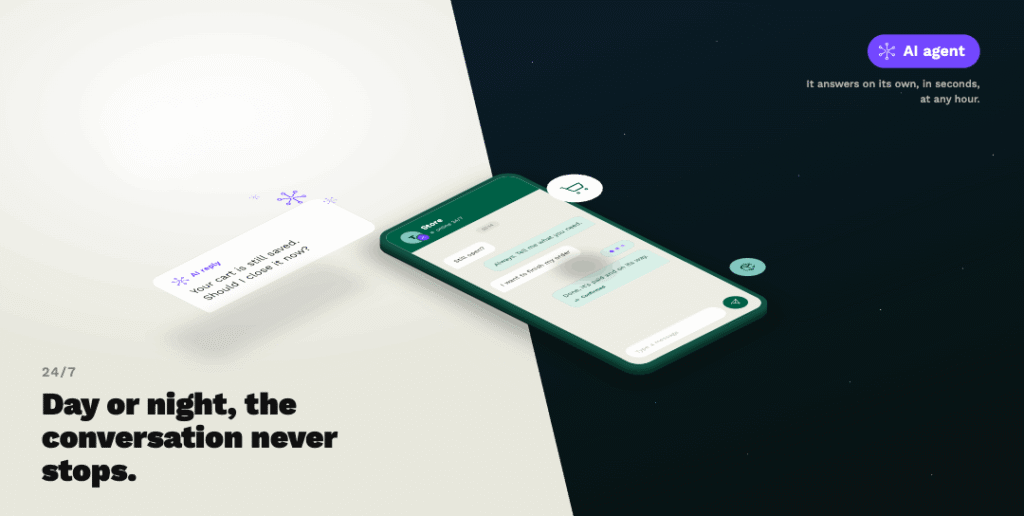
There’s a scene that plays out thousands of times a day across Latin America: someone sends a WhatsApp message to a brand at 11:47 pm asking about a product’s price. If nobody answers, that person is already messaging a competitor before the sun comes up.
That’s essentially the problem artificial intelligence in WhatsApp was built to solve. It’s not a trend or a buzzword to sound innovative in a board meeting: it’s the difference between closing a sale or losing it because you weren’t there the exact moment someone wanted to buy.
In this article, we’ll break down how AI is transforming WhatsApp sales, what virtual assistants can (and can’t) do today, and how to get started without turning your sales channel into a cold chatbot that pushes customers away instead of pulling them in.
Why WhatsApp became Latin America’s favorite sales channel
Before we talk about AI, it’s worth understanding why this channel matters so much. WhatsApp has open rates above 90%, compared to 20-30% for email. People don’t check WhatsApp once a day like email — they keep it open all day, every day.
For sales, that translates into something very concrete: conversations that start on WhatsApp convert faster because the customer is already in an intimate, direct, low-friction channel. No app to download, no account to create. Just type.
The problem is that same conversation volume becomes impossible to manage manually as a business grows. That’s where AI comes in.
What AI on WhatsApp can actually do (no exaggeration)
‘Selling with AI’ gets thrown around a lot, so let’s get specific. A well-implemented AI assistant on WhatsApp can:
- Answer FAQs instantly, so a salesperson doesn’t have to type the same answer for the twentieth time (“do you ship to my city?”, “how much does it cost?”, “do you have this in size M?”).
- Automatically qualify leads, identifying who’s ready to buy and who’s just browsing, before handing them off to a human rep.
- Recommend products based on what the person writes, the way a good in-store salesperson asks questions before offering options.
- Follow up on abandoned conversations — that half-finished cart or the quote nobody confirmed.
- Schedule and confirm appointments or orders without human intervention — ideal for clinics, services, and ecommerce.
- Sell outside business hours, which in practice is where a large share of volume happens: nights, weekends, holidays.
What AI shouldn’t do is fully replace human conversation at high-value moments. A customer about to close a big purchase, or dealing with a sensitive complaint, needs to feel there’s a real person on the other end. AI works best as the first filter and the engine that never sleeps — not as a full replacement for your sales team.
The most common mistake: automating without a strategy
Many brands make the same mistake when rolling out AI on WhatsApp: they turn on a bot, let it run, and expect sales to rise on their own. Two things tend to happen when this fails:
- The bot sounds robotic and generic, and the customer notices immediately. Nobody wants to feel like they’re talking to a machine when trying to solve something as important as a purchase.
- There’s no clear handoff point to a human, so the customer gets stuck in a loop of automated replies with no way to move forward.
AI on WhatsApp works when it’s designed as part of a real sales flow: clear rules for when to escalate to a person, a tone that sounds like the brand (not a call center manual), and content trained on the real questions your customers ask — not generic scripts.
Where AI on WhatsApp is already moving the needle
A few examples of where this is working day to day:
- Retail and ecommerce: an AI assistant answers stock, size, and price questions in seconds and guides the customer straight to the payment link, all within the same chat. The direct result is less cart abandonment from slow responses.
- Healthcare and services: clinics use AI to schedule appointments, confirm attendance, and answer common treatment questions, freeing up staff for the consultations that actually require medical judgment.
- Education and courses: virtual assistants qualify prospects by purchase intent before handing them to an advisor, saving hours of manual follow-up on leads who weren’t ready to pay.
In every case, the pattern repeats: AI handles volume and speed, and the human team focuses on closing.
How to start using AI on WhatsApp to sell more
If you’re considering implementing this, these are the steps that separate a project that works from one that stalls:
- Define which conversations to automate first. Don’t try to cover the whole sales funnel at once. Start with the most repetitive questions or the point where you lose the most leads.
- Use the WhatsApp Business API, not the free app. The WhatsApp Business app works for small businesses, but it doesn’t support real AI integration or scaling beyond one device or agent. The API is the gateway to serious automation.
- Train the assistant on your real content, not manual scripts. The more specific the knowledge you feed it, the less generic it sounds.
- Set clear escalation rules to humans. The best systems know exactly when to step back and hand the conversation to a person.
- Measure and adjust. Which questions the assistant couldn’t answer, where conversations drop off, how long it takes to convert. AI improves with data, not with a one-time setup you forget about.
The real advantage isn’t automation, it’s speed
At the end of the day, what makes AI on WhatsApp sell more isn’t that it’s “smart” — it’s that it’s available the exact second someone wants to buy, no matter the time or the message volume. In a channel where the first response determines whether you win or lose the customer, that speed is the hardest competitive edge to match with an all-human team.
Brands already using it didn’t take the human touch out of their sales — they gave it back, by freeing their team from answering the same question a hundred times a day so they could focus on closing the conversations that actually matter.