What makes a WhatsApp platform good for e-commerce?
Quick answer: a good WhatsApp marketing platform for e-commerce uses the official WhatsApp Business API, recovers abandoned carts automatically, integrates with your store and your CRM, combines AI with human support, and shows how much each campaign sold. If a tool doesn’t meet these points, it sends messages, but it won’t necessarily drive sales.
WhatsApp marketing for e-commerce means using WhatsApp as a sales, relationship, and post-sale channel for an online store. It includes promotional campaigns, cart reminders, order confirmations, support, and repeat purchases, all inside the app customers already use every day.
In this article, you’ll find:
- Why WhatsApp is essential for e-commerce in Brazil
- Seven points to evaluate before choosing a platform
- The most common mistakes when selling on WhatsApp
- How cart recovery via WhatsApp works
- What Treble can do for your store
Why WhatsApp is an essential sales channel for e-commerce in Brazil
Brazil is one of the largest WhatsApp markets in the world, and the app is part of the daily routine of practically every consumer who shops online. For e-commerce in Brazil, this means customers prefer to ask questions, track orders, and receive offers there rather than by email.
According to the WhatsApp in Brazil survey by Opinion Box, the app is installed on about 99% of smartphones in the country and has roughly 147 million users. 97% of them use WhatsApp every day or almost every day, and 37% say they keep the app open practically all day. Brazil is the second-largest WhatsApp market in the world, behind only India (Statista).
WhatsApp sales work well for three reasons:
- Reach: WhatsApp messages have much higher open rates than email.
- Conversation: customers can reply instantly, ask questions, and complete the purchase without leaving the chat.
- Right timing: cart reminders, delivery updates, and repeat-purchase offers arrive while the customer is still deciding.
But using WhatsApp for online stores at scale requires a platform. The regular app and the WhatsApp Business app don’t support advanced automation, multiple agents, or integration with your store. For that, you need the official WhatsApp Business API, accessed through an official Meta partner (BSP).
7 points to evaluate before choosing a WhatsApp marketing platform
Not all WhatsApp marketing platforms are the same. These points determine whether a platform will drive sales or just send messages.
- Official API and Meta partnership. Choose a Meta Business Partner. This ensures stability, fast access to new features (like WhatsApp Flows), and a lower risk of your number being blocked.
- Cart recovery. The platform should send automatic messages when a customer abandons their cart, with the product, a link back, and, when it makes sense, a coupon.
- Automation and segmentation. Look for trigger-based flows (sign-up, purchase, inactivity), behavior-based segmentation, and bulk campaigns with approved templates.
- Native integrations. The platform needs to connect with your store (like Shopify) and your CRM (like HubSpot, Salesforce, or Pipedrive). Without this, data stays scattered and personalization doesn’t happen.
- AI with human support. An AI agent that answers questions, qualifies customers, and hands off to a person when needed cuts response time without losing the sale.
- Opt-in and number quality. The tool should help you collect customer consent and segment your sends. Indiscriminate sends lower your number’s quality and limit your reach.
- Metrics and cost clarity. Conversion reports by campaign and transparency about what you pay for the platform and for Meta’s messages.
Common mistakes when selling on WhatsApp
Even with the right platform, some mistakes hurt WhatsApp sales results:
- Using the regular app at scale. It works at first, but it stalls as volume grows and puts your number at risk.
- Sending without opt-in. Messages to people who didn’t ask for them lead to blocks and reports, and Meta reduces your number’s reach.
- Generic messages. The same offer for everyone converts less than a message with the customer’s name and the product they viewed.
- Scattered data. Without store and CRM integration, your team doesn’t know who bought, who abandoned their cart, and who needs a nudge.
- Not measuring. Without campaign metrics, it’s impossible to know what sells and what only adds cost.
How cart recovery via WhatsApp works
Cart recovery via WhatsApp sends an automatic message to customers who left products in their cart, with a direct link to complete the purchase. It’s one of the highest-return automations for online stores.
The basic flow has four steps:
- Trigger: the store (for example, Shopify) detects the abandoned cart and sends the event to the WhatsApp platform.
- First message: after 30 to 60 minutes, the customer gets a reminder with the product and the cart link.
- Second touch: if there’s no purchase within 24 hours, a new message can include a coupon, free shipping, or an answer to the most common objection.
- Conversation: if the customer replies with a question, the AI or an agent takes over and helps close the sale.
Sample message:
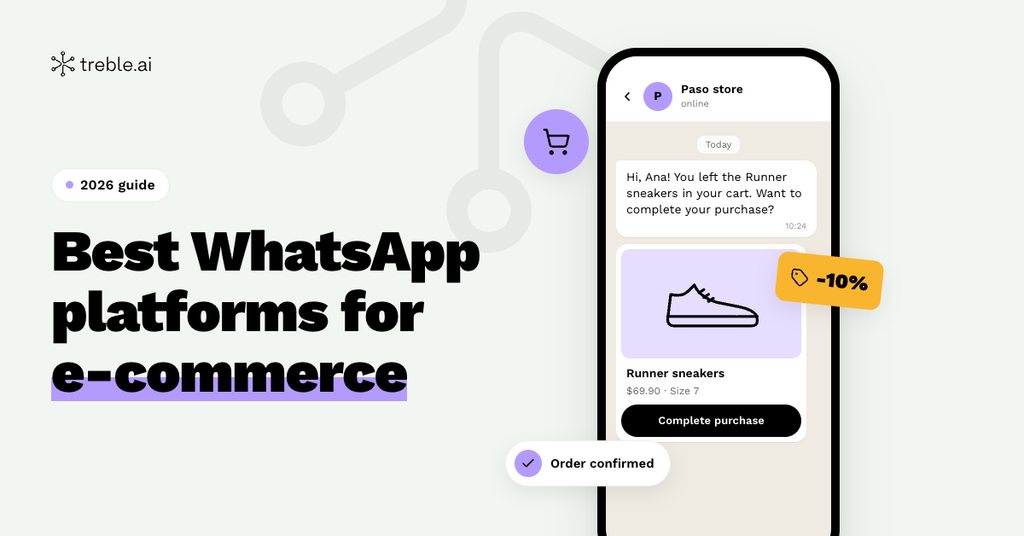
Hi, Ana! We noticed you left the Runner Sneakers in your cart. They’re still available in your size. Want to complete your purchase? 👉 [link]
Best practices: ask for customer opt-in at checkout, personalize with name and product, limit reminders to two or three, and measure the recovery rate by campaign.
What Treble can do for your e-commerce business
Treble is a WhatsApp Business API platform, a Meta Business Partner and a HubSpot Leading Partner, operating in Brazil and Latin America. It was backed by Y Combinator.
For online stores, Treble offers:
- Segmented bulk campaigns with Meta-approved templates
- Automatic cart recovery through integration with Shopify and other platforms via API
- Treble’s AI agent assistant, which talks naturally (not like a chatbot), creates and updates CRM properties, saves relevant customer information, and hands off to a human agent when needed
- Native integrations with HubSpot, Salesforce, Pipedrive, ActiveCampaign, Google Calendar, and Shopify, plus an open API
- WhatsApp Flows for forms, catalogs, and purchase journeys inside the chat
- A single invoice: Treble acts as the intermediary with Meta. You pay everything to Treble, and Treble pays Meta for the messages, with no commission on that amount
Checklist before signing up
- ☐ Is the platform an official Meta partner?
- ☐ Does it have cart recovery integrated with your store?
- ☐ Does it integrate natively with your CRM?
- ☐ Does it offer AI with handoff to a human agent?
- ☐ Does it help you collect opt-in and segment your sends?
- ☐ Does it show sales results by campaign?
- ☐ Is the cost model clear (platform + Meta messages)?
Frequently asked questions about WhatsApp marketing for e-commerce
What is the best WhatsApp platform for e-commerce in Brazil?
The one that uses the official API, recovers carts automatically, integrates with your store and your CRM, combines AI with human support, and shows results by campaign. Treble meets all of these points and is a Meta Business Partner.
Can I use the WhatsApp Business app for my online store?
Yes, but only for small operations. The app doesn’t support advanced automation, campaigns at scale, or integration with your store. For that, you need the official WhatsApp Business API.
What is WhatsApp marketing automation?
It’s the automatic sending of messages based on triggers, such as an abandoned cart, a first purchase, or an inactive customer. The platform sends the right message at the right time, with no manual work from your team.
How much does the WhatsApp API cost?
The cost has two parts: the platform subscription and the fees Meta charges per template message sent. The amount varies by message type (marketing, utility, or authentication) and volume. With Treble, you don’t have to deal with multiple invoices: Treble acts as the intermediary, the customer pays everything to Treble, and Treble pays Meta the corresponding amount for the messages, with no commission on that amount.
How do I keep my number from being blocked?
Use the official API through a Meta partner, only message customers who have opted in, segment your campaigns, and avoid repetitive sends. Your number’s quality depends on how customers react to your messages.
Does WhatsApp work for recovering abandoned carts?
Yes. Because customers open it frequently, WhatsApp is one of the most effective cart recovery channels, especially when the message includes the product, a direct link, and the option to ask questions in the chat.
Conclusion
WhatsApp marketing for e-commerce is no longer optional in Brazil. Before choosing a platform, check that it uses the official API, recovers carts automatically, connects to your store and your CRM, and shows how much each conversation sold.
If your store wants to scale WhatsApp sales with automation, AI, and native integrations, Treble was built for that.