Choosing the wrong WhatsApp Business API provider is not a small mistake. It’s the difference between a stable account that drives your sales and support, or a blocked number, a chatbot that never responds properly, and a support team that takes three days to answer an urgent ticket.
In LatAm, where WhatsApp is practically the default communication channel between businesses and customers, this decision carries more weight than many businesses realize at first. And with dozens of providers offering “the same thing” on the surface, knowing what to ask and what to look for closely can save you months of headaches (and money).
Here’s exactly what a BSP is, and the 8 criteria you should evaluate before signing any contract.
What Exactly Is a BSP?
BSP stands for Business Solution Provider, a company officially certified by Meta to give other businesses access to the WhatsApp Business API. In other words, it’s the technical and commercial intermediary between your company and Meta.
It’s easy to confuse this with other terms:
ISV (Independent Software Vendor): builds software on top of the API, but doesn’t necessarily hold direct Meta certification or manage the channel’s infrastructure.
Direct with Meta: in theory you could request direct access from Meta, but in practice almost no business does this — it’s a complex technical process, with no dedicated support, and none of the management tools a BSP provides.
A good BSP doesn’t just give you technical access to the channel. It gives you infrastructure, support, automation tools, and — very importantly — protects you from Meta policies that, if broken unknowingly, can get your account blocked.
With that clear, let’s get into the criteria.
1. Official Meta Business Partner Status (Verification)
Why it matters: not everyone who calls themselves a “BSP” holds real Meta certification. Some are resellers of other BSPs, which adds an extra layer of intermediaries, costs, and less control over service quality.
How to evaluate it: ask them to show you their status directly on the Meta Business Partner Directory. A certified BSP will appear there under its official name. If they can’t show you this, that’s a red flag.
Concrete thing to ask: “What is your exact name as a verified Business Partner on Meta?”
2. Number Quality and Stability (Quality Rating)
Why it matters: Meta assigns a quality rating to every WhatsApp Business number based on how users respond to your messages (blocks, reports, response rate). A BSP without good management practices can let your number drop from “High” quality to “Medium” or “Low” without you noticing until it’s too late — and that limits how many messages you can send per day.
How to evaluate it: confirm that the platform gives you real-time visibility into your number’s quality, so you can monitor it yourself constantly, without depending on someone else to alert you.
Example: without this direct visibility, you might only find out your messaging limit dropped right in the middle of an important campaign — with customers waiting for a reply and no way to send them anything.
3. Native Integrations With Your Stack
Why it matters: WhatsApp doesn’t live in isolation. Depending on your operation, you may need to connect the channel to your CRM, your database, or tools like HubSpot or Google Sheets to automate real workflows — although not every business needs this: many use the API effectively without a CRM at all.
How to evaluate it: what matters is assessing feasibility for your specific case: which native integrations already exist, what can be built via API, and how flexible the provider is in adapting to your stack (or lack of one).
Key question: “What native integrations do you have available, and how feasible is it to connect [your specific tool, if applicable] via API?”
4. Spanish/Portuguese Support With Real Knowledge of the LatAm Market
Why it matters: Meta’s policies, use cases, and even customer service hours vary by region. Generic English-language support, operating in another continent’s time zone, won’t resolve an account block on a Saturday at 8pm Colombia time.
How to evaluate it: ask directly what languages and hours support operates in, and whether they have a local presence or team in LatAm (not just “we support Spanish” from a generic call center).
5. Transparent Pricing (Setup, Conversations, Markup)
Why it matters: the WhatsApp Business API pricing model has several layers: the cost Meta charges per conversation, and the markup the BSP adds for its service. Some providers aren’t clear about where one ends and the other begins, making it nearly impossible to compare real prices between options.
How to evaluate it: ask them to break down exactly: setup cost, cost per conversation (and whether it varies by category: marketing, utility, service), and the BSP’s specific markup on top of Meta’s cost.
Key question: “Can you show me the exact breakdown between what Meta charges and what you charge as the BSP?”
6. Included Automation and AI Tools
Why it matters: today, a BSP that only gives you “api access” without automation tools or conversational AI leaves you with more technical work than you can likely take on internally. And many providers charge for these tools as costly add-ons instead of including them as part of the base value.
How to evaluate it: ask specifically what’s included versus what’s an additional cost: chatbots, AI agents, automated flows, templates, reporting.
Example: a well-trained AI agent (like TOM, Treble’s assistant) can resolve repetitive queries without human intervention — but if that costs extra on top of your base plan, the real savings may not be as large as they appear in the sales proposal.
7. Meta Compliance and Policies (Avoiding Blocks)
Why it matters: Meta is strict about things like unsolicited bulk messaging, miscategorized templates, or violations of its commercial policy. A BSP that doesn’t actively guide you here leaves you exposed to blocks that can bring your commercial operation to a halt overnight.
How to evaluate it: ask whether you have clear visibility into the type of template you’re selecting (marketing, utility, service), and whether there’s a way to adjust it if you’ve chosen an unsuitable category, before it causes a problem with Meta.
Key question: “If my account gets blocked, what’s your support process and how long does it typically take to resolve?”
8. Verifiable Success Stories in the Region
Why it matters: it’s easy to promise results on a sales call. What really matters is whether the provider has real, verifiable cases with companies in your industry or of similar size operating in LatAm.
How to evaluate it: ask for direct references or published case studies with concrete metrics (not just generic testimonials). Ideally, from companies in your same sector — for example, if you’re a clinic or healthcare business, a case like Boston Medical Group tells you far more than a generic e-commerce case.
Checklist Before You Sign
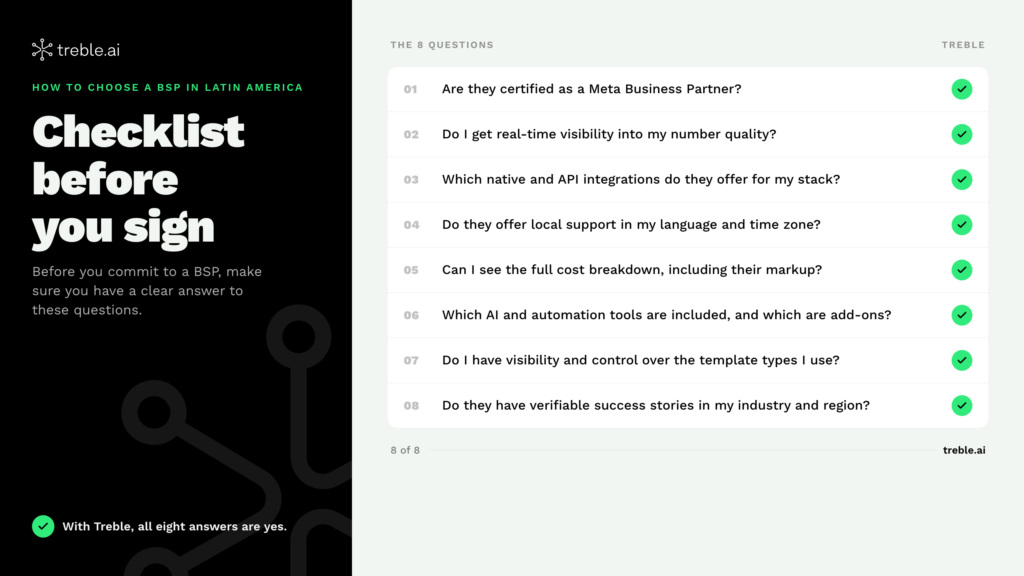
Before committing to a BSP, make sure you have clear answers to these questions:
- Are they certified as a Meta Business Partner? (verified, not just claimed)
- Do I have real-time visibility into my number’s quality?
- What native and API integrations do they have available for my stack?
- Do they have local support in my language and time zone?
- Can I see the full cost breakdown, including their markup?
- What AI/automation tools are included vs. add-ons?
- Do I have visibility and control over the template type I use?
- Do they have verifiable success stories in my industry and region?
The Bottom Line
Choosing a BSP shouldn’t feel like a gamble. With these 8 clear criteria, you can compare providers objectively and avoid costly surprises down the road.
At Treble.ai, we’re an official Meta Business Partner and HubSpot “Leading” partner, recognized on G2, with an established presence across LatAm and Brazil. If you’re evaluating options, we’re happy to show you how we work and what sets us apart — no commitment required yet.