WhatsApp has become the channel where your customers actually want to talk to you. The problem isn’t the channel, it’s that in most companies, WhatsApp lives on its own. A chat open in one tab, disconnected from the CRM, from purchase history, from the support ticket that same customer opened yesterday. When that happens, WhatsApp stops being an advantage and becomes an island of information nobody else on your team can see.
The difference between an isolated WhatsApp and an integrated one isn’t technical, it’s a business difference. And it comes down to three things: context, traceability, and centralization.
What does it mean for WhatsApp to be “isolated”?
An isolated WhatsApp is one that runs on its own: a number, an app, and an agent replying without knowing anything about the customer beyond what that customer types in the moment. They don’t know if the customer already bought before, if there’s an open support case, or what the sales team promised last week.
The result is predictable: the customer repeats their issue three times, the agent improvises answers without context, and the information from that conversation disappears the moment the chat closes. No one else in the company ever finds out it happened.
Context: every conversation starts where it should
When WhatsApp is integrated with your CRM or helpdesk, every incoming message carries the customer’s full history: what they bought, what they were promised, which tickets are open, where they are in the funnel. The agent doesn’t start from zero, they pick up exactly where the last conversation left off.
That context radically changes the customer experience. They no longer have to explain their situation all over again; the conversation simply continues as if it were never interrupted. And for your team, every response is more accurate because it’s based on real information, not on what the customer manages to fit into a single message.
Discover the success story of Nstech.
Traceability: knowing what happened, without chasing anyone down
Without integration, the traceability of a WhatsApp conversation depends on whoever handled it remembering the details, or on screenshots forwarded over Slack. With integration, every conversation gets logged in the same place where the rest of the customer’s information lives: who responded, how long it took, what was agreed, and what happened next.
This isn’t just about being organized. It’s what lets you audit service quality, measure real response times, and understand what’s actually working in your conversations without having to ask every agent how it went.
Centralization: one operation, not scattered channels
Most companies don’t run on WhatsApp alone. They have email, web forms, social media, maybe another messaging channel. When each one lives separately, your team ends up jumping between screens just to understand one customer’s full story.
Centralizing WhatsApp together with your other channels in one platform means your sales, support, and marketing teams see the same information, at the same time, without duplicating work. Fewer tools open, fewer handoffs where information gets lost between teams, and an operation that actually works as one, instead of several teams working in parallel without talking to each other.
How treble.ai solves this
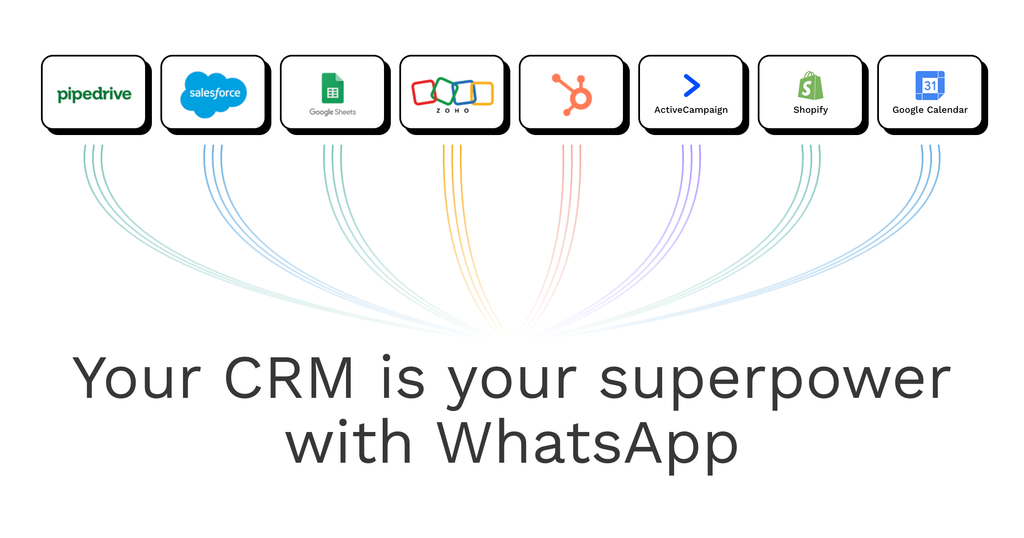
At treble.ai, we offer native integrations with the tools your operation already runs on: HubSpot, Salesforce, Pipedrive, ActiveCampaign, Shopify, and Google Calendar. That means WhatsApp connects directly to your CRM, your store, or your calendar, no custom development required.
And if your stack includes other tools, we make our API available so you can build the integration your operation needs.
What your business gains by integrating WhatsApp
The benefits of context, traceability, and centralization aren’t just operational, they translate directly into business results:
- Conversion: agents close deals faster when they don’t have to rebuild the customer’s history with every message.
- Retention: customers feel remembered by the brand, instead of talking to a chatbot that forgets everything between sessions.
- Efficiency: less time lost jumping between tools, more time resolving conversations.
- Visibility: team leaders can measure what’s actually happening on WhatsApp, instead of operating blind.
The next step
Integrating WhatsApp with your CRM or helpdesk isn’t a massive technical project, it’s a decision about how you want your team to work. The question isn’t whether WhatsApp deserves to be connected to the rest of your operation, but how much context you’re still willing to lose while it isn’t.
Continue reading “Every Reply Starts to Have a Price: What’s Changing on WhatsApp in October”