When most businesses think about WhatsApp Business, the first thing that comes to mind is “sending offers” or “closing a quick sale.” And yes, WhatsApp is great for that. But limiting it to a transactional channel means wasting its real potential.
WhatsApp has everything it needs to become the central channel of the entire customer journey: from first contact all the way to loyalty and repeat purchases. The difference between using it as a simple message trigger and using it as a strategic channel lies in how you manage the conversation, traceability, and the data generated in every interaction.
In this article, we explain why WhatsApp should accompany the full customer journey, and how to make that happen, whether or not you have a CRM integration.
The problem: WhatsApp treated only as a transactional channel
Many businesses use WhatsApp reactively: they answer questions, send a catalog, close the sale, and the relationship ends there until the next mass campaign. Each conversation is treated as an isolated event, disconnected from what happened before or what comes next.
The result is predictable: context gets lost, agents repeat questions the customer already answered, and repeat-purchase or upsell opportunities are left on the table because no one has visibility into the full history.
This isn’t a major strategic mistake, it’s simply failing to take advantage of a channel that, by nature, already generates a structured, persistent conversation history.
The full journey can live inside WhatsApp
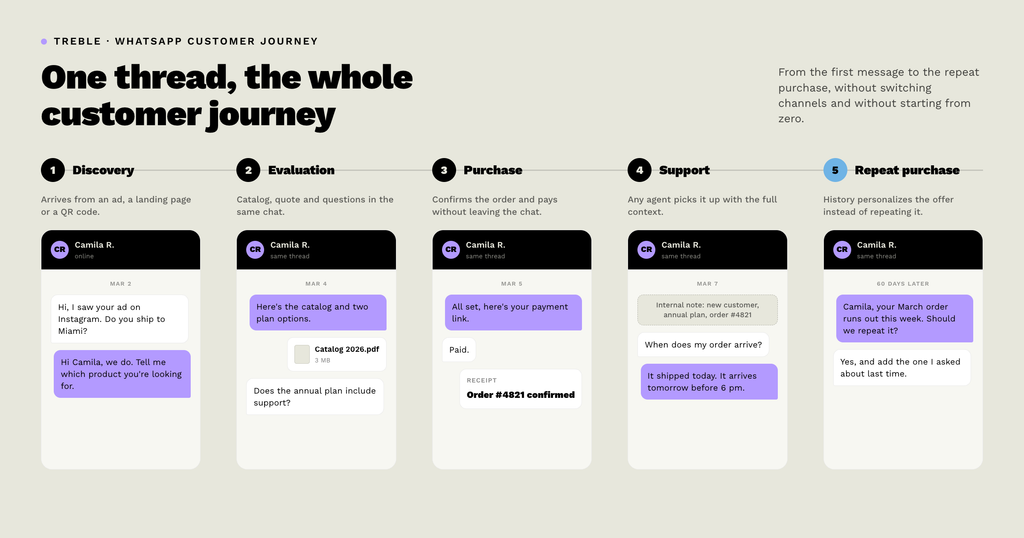
A typical customer journey moves through several stages: discovery, evaluation, first purchase, after-sales support, repeat purchase, and loyalty. The interesting part is that WhatsApp can accompany every one of them without the customer ever switching channels:
- Discovery: a lead arrives through an ad, a landing page, or a QR code and starts the conversation on WhatsApp.
- Evaluation: they resolve questions, receive catalogs or quotes, and compare options, all within the same thread.
- Purchase: they confirm the order and receive a receipt or payment link.
- Support: they track their order and get help with after-sales issues.
- Repeat purchase and loyalty: they receive personalized recommendations based on their real conversation and purchase history.
When all of this happens on the same channel and is recorded, the customer experience feels continuous instead of fragmented.
Traceability: why conversation history matters
Having traceability means being able to see the full conversation with a lead or customer, not just the last message. This completely changes the quality of service:
- A new agent can pick up a conversation without asking the customer to repeat everything from scratch.
- You can identify which funnel stage each lead is in and prioritize follow-up accordingly.
- You can audit what was promised or agreed with a customer in case of complaints or questions.
Without traceability, every interaction is an island. With traceability, every interaction adds to an increasingly complete customer profile. Learn more about our multi-agent platform.
Repeat purchases: using history to personalize, not to repeat the same message
One of the most underused opportunities on WhatsApp is the repeat purchase. If you already know what a customer bought, when they bought it, and what questions they had along the way, you have everything you need to offer them something relevant at the right moment, instead of sending the same generic promo to your entire list.
Concrete examples:
- Repurchase reminders based on the product’s consumption cycle (for example, supplements, supplies, recurring services).
- Upsell offers related to the previous purchase.
- Re-engaging leads who requested a quote but didn’t buy, picking up exactly where the conversation left off.
This is made possible through HSM templates for remarketing and by making good use of WhatsApp Flows to capture preferences during the conversation.
Lead data: what you can capture without friction
A well-structured WhatsApp conversation naturally generates valuable data, without needing long forms that scare leads away:
- Purchase intent and the funnel stage the lead is in.
- Product or service preferences mentioned during the conversation.
- Recurring objections or questions (key information for both sales and marketing).
- Contact details and basic segmentation (location, customer type, source channel).
WhatsApp Flows are especially useful here, since they let you capture this information in a structured way within the same chat, without the customer feeling like they’re filling out a form.
With or without a CRM: how to keep the journey organized
Not every business has a CRM integrated with its WhatsApp Business API, and that shouldn’t be an excuse to underuse the channel.
If you have CRM integration:
- Conversation history syncs automatically with the customer’s profile.
- You can automate repurchase or follow-up reminders based on the funnel stage.
- Traceability is practically automatic across channels (WhatsApp, email, sales).
If you don’t have CRM integration:
- You can use tags within your WhatsApp Business platform to segment leads by stage or interest.
- Internal notes per conversation help any agent understand the context quickly.
- Basic manual segmentation (for example, by product interest or last contact date) already lets you personalize far more than sending the same message to your entire list.
CRM integration boosts the process, but it isn’t a requirement to start treating WhatsApp as a strategic channel instead of a transactional one.
WhatsApp as the memory of your customer relationship
In the end, the difference between using WhatsApp just to sell and using it as the central channel of the customer journey comes down to one idea: every conversation should add context, not start from zero.
When you achieve that, WhatsApp stops being a message-trigger channel and becomes the living memory of the relationship with each customer: what they bought, what they asked, what they’re interested in, and where they are in the journey. That’s the real foundation for building repeat purchases, loyalty, and a customer experience that feels personal, even at scale.
Continue reading WhatsApp Response Rate: How to Know If Yours Is Good